Learn
Tornado Watch vs Warning: What's the Difference?
A tornado watch means conditions are favorable for tornadoes over a large area for the next several hours, so get ready. A tornado warning means a tornado has been sighted or indicated by weather radar for a much smaller area in its path, so take shelter now. Watches come from NOAA's Storm Prediction Center; warnings come from your local National Weather Service office. A tornado emergency is the rare, highest level of warning, for a violent tornado already causing catastrophic damage.
Watch, warning and emergency side by side
| Tornado watch | Tornado warning | Tornado emergency | |
|---|---|---|---|
| Meaning | Tornadoes are possible in and near the watch area | A tornado has been sighted or indicated by radar; imminent danger | A violent tornado is on the ground with a severe threat to life and catastrophic damage |
| Issued by | Storm Prediction Center (Norman, Oklahoma) | Your local NWS forecast office | Your local NWS forecast office |
| Area | Typically 20,000 to 40,000 square miles (52,000 to 104,000 km²), many counties or several states | Around the size of a city or small county, drawn along the storm's path | The path of that tornado |
| How long | Typically 6 to 8 hours; can be extended or cancelled | Until the storm leaves the polygon or the warning expires; new warnings follow the storm | While the tornado lasts |
| What to do | Review your plan, check your shelter, stay alert | Go to shelter immediately | Shelter in the safest place you can reach, now |
The National Weather Service sums it up as Tornado Watch: Be Prepared! and Tornado Warning: Take Action! A warning can be issued without a watch, and a tornado can happen in a severe thunderstorm watch: the Storm Prediction Center says a tornado can occur in either type of watch.
- Go to the lowest floor. Move to a basement, storm shelter or safe room; if there is none, an interior room on the lowest floor away from windows.
- Leave a mobile home. Mobile homes and tents are not safe; get to a sturdy building or shelter you planned for in advance.
- Protect yourself from debris. Flying debris is the main danger; stay away from windows and cover your head.
- If you are in a vehicle. Drive to the closest sturdy shelter if you can; if not, stay buckled and get your head below the windows, or lie in a ditch away from the car. Never shelter under an overpass.
- Stay put until it expires. Keep following NWS updates; storms can produce more than one tornado.
The official definitions
From the NWS: a tornado watch means "Tornadoes are possible in and near the watch area. Review and discuss your emergency plans, take inventory of your supplies and check your safe room." A tornado warning means "A tornado has been sighted or indicated by weather radar. There is imminent danger to life and property."
Every SPC watch text repeats the meaning. Tornado Watch 170, issued at 10:45 am CDT on 28 April 2026 for parts of Arkansas, northern Louisiana, south-east Oklahoma and north-east Texas, said: "REMEMBER...A Tornado Watch means conditions are favorable for tornadoes and severe thunderstorms in and close to the watch area."
SPC issues a tornado watch rather than a severe thunderstorm watch when conditions favor multiple tornadoes or a single intense tornado. When it expects multiple intense (EF2 to EF5) tornadoes with high confidence, it adds the words THIS IS A PARTICULARLY DANGEROUS SITUATION, a PDS watch.
Reading a tornado warning: the tags
NWS tornado warnings are impact-based: the text carries tags that tell you how the tornado was detected and how bad the damage could be.
| Tag | What it means |
|---|---|
| TORNADO...RADAR INDICATED | Radar shows a tornado or developing tornado, but it is not confirmed |
| TORNADO...OBSERVED | Confirmed by radar (for example, debris detected) or reliable reports |
| No damage tag (base warning) | The default warning |
| CONSIDERABLE (PDS warning) | Rare: a considerable threat to life and property from a strong, ongoing tornado |
| CATASTROPHIC (tornado emergency) | Exceedingly rare: a violent tornado capable of catastrophic damage is ongoing |
"Radar indicated" does not mean "probably nothing". Many tornadoes are hidden by rain or darkness and are only confirmed later. All tornado warnings trigger Wireless Emergency Alerts on capable phones.
What a warning looks like on radar
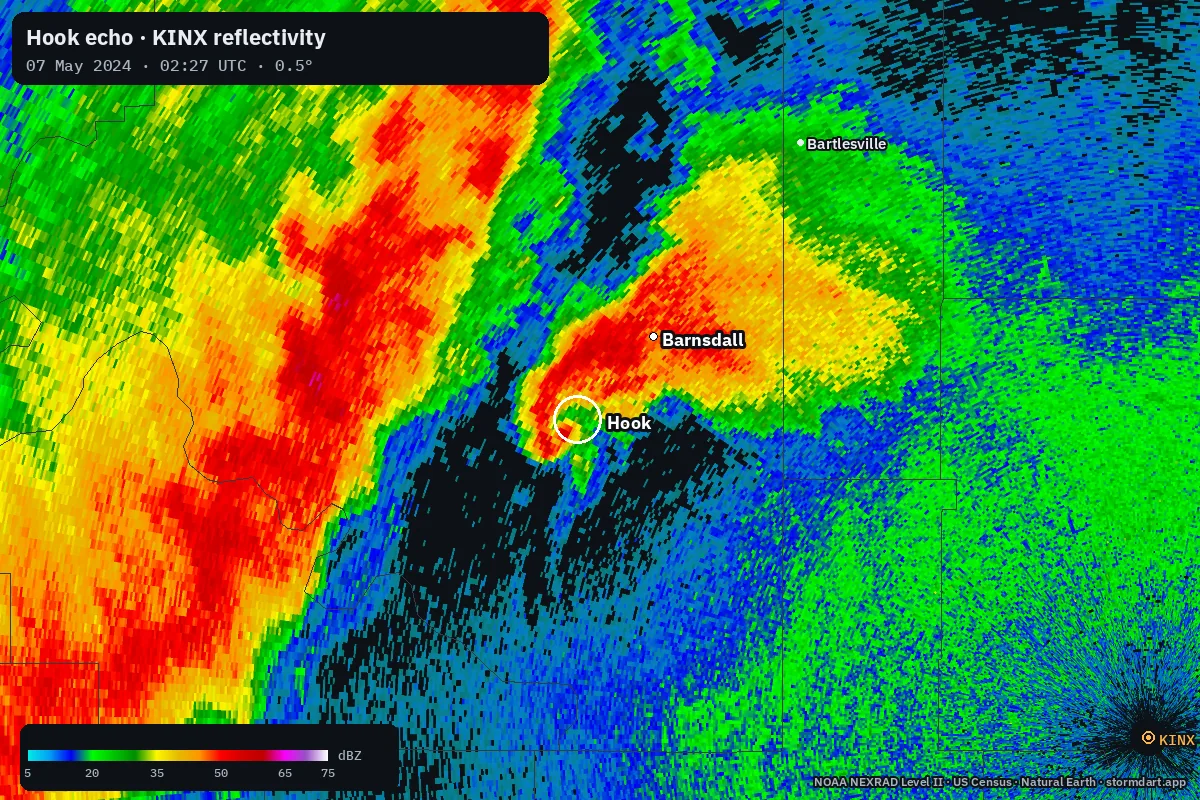
This is the kind of radar picture behind a radar-indicated warning: the KINX scan at 02:27 UTC on 7 May 2024 (9:27 pm CDT on 6 May), with a tight hook echo curling around a notch of weak echo about 6 km (4 miles) south-west of Barnsdall, Oklahoma. On the matching velocity scan there was a strong velocity couplet at the same spot. Within about ten minutes the rotation passed Barnsdall; the tornado was later rated EF4. It was dark, which is exactly when radar and warnings matter most, because nobody can see the tornado. Our Barnsdall case shows the full sequence.
Radar apps, including ours, are not a warning service. A forecaster combines radar, spotter reports and experience; you should act on the official warning, not on your own reading of a radar image.
Mistakes people make
- Waiting to see or hear it. Rain-wrapped and night-time tornadoes are hard or impossible to see. Shelter when the warning comes.
- Relying on one alert source. Have at least two ways to get warnings, especially at night: a phone with Wireless Emergency Alerts and a NOAA Weather Radio or local broadcast.
- Ignoring a watch because the sky is blue. Watches are often issued before storms form; SPC aims for about two hours of lead time on a tornado watch.
- Driving away in traffic. The Storm Prediction Center calls vehicles extremely risky in a tornado, and overpasses offer no protection.
- Assuming a watch means a tornado will happen. SPC says a watch is not a warning and not a guarantee of severe weather. Treat it as the time to get ready.
Questions
Which is worse, a tornado watch or a tornado warning?
A warning. A watch means tornadoes are possible in a large area; a warning means one is happening or about to in your specific area, and you should take shelter right away.
What is a tornado emergency?
It is the National Weather Service's highest tornado alert, issued in exceedingly rare cases when a violent tornado is on the ground with a severe threat to human life and catastrophic damage.
How long does a tornado watch last?
Typically 6 to 8 hours, according to the Storm Prediction Center. Local NWS offices can cancel it early, extend it or add counties.
Can there be a tornado warning without a tornado watch?
Yes. SPC says warnings sometimes come before a watch, and short-lived or isolated storms may be handled with warnings alone.
Sources
- Understand Tornado Alerts (National Weather Service) (www.weather.gov)
- SPC Products (NOAA Storm Prediction Center) (www.spc.noaa.gov)
- Tornado Impact-Based Warnings (National Weather Service) (www.weather.gov)
- What to do During a Tornado (National Weather Service) (www.weather.gov)
- The Online Tornado FAQ (NOAA Storm Prediction Center) (www.spc.noaa.gov)
Keep reading
SPC Convective Outlooks: Risk Levels Explained
SPC outlooks rate severe storm risk 1 to 5: Marginal, Slight, Enhanced, Moderate, High. What each level means, how…
LearnSPC Mesoscale Discussions Explained
A mesoscale discussion (MD) is a short SPC bulletin on what storms will do in one area over the next few hours, often…
LearnHook Echo: What It Means on Radar
A hook echo is a hook-shaped curl of reflectivity on the right-rear side of a supercell around its rotating updraft.…
LearnVelocity Couplet: How to Spot Rotation on Radar
A velocity couplet is bright inbound beside bright outbound across the beam: rotation. How to measure Vrot, what TVS…
LearnTornado Debris Signature (TDS) and the Debris Ball
A TDS is a spot of very low correlation coefficient (below about 0.85) right on a velocity couplet: debris lofted by a…
Tornado caseBarnsdall Tornado (2024) on Radar
The Barnsdall–Bartlesville EF4 of 6 May 2024 killed 2 people. KINX loop, the hook, couplet and debris signature at…